
Thom Hornback has spent two decades running large implementation projects inside big organisations. Six Sigma black belt, PMP, and someone who thinks hard about the people side of change. When he came across a way of modelling processes based on the information they generate, consume, and destroy, he tried to get it funded at GE Power. The idea went nowhere. As he puts it, “The value of information is not a concept that organizations tend to track.”
That single observation sits at the centre of Doug Laney’s new column in CIO, and it should be uncomfortable reading for anyone who has ever signed off a transformation business case.
Business process reengineering. Lean. Six Sigma. RPA. Now agentic AI. Every wave arrived with real methodology and impressive case studies, and yet Bain found that 88% of business transformations fail to hit their original ambitions. Gartner reports that 67% of CFOs think their digital spending is underperforming, and that only 30% of CFO-CIO relationships qualify as strong digital partnerships.
Doug’s argument is that this isn’t primarily a delivery problem. It’s a definition problem. Traditional process methods are built to measure what a process consumes: time, headcount, cost per transaction, cycle time. They were never designed to ask what a process is worth. So programmes get judged on the denominator, and the numerator goes unexamined.
Efficiency measures output per unit of input. It is completely indifferent to whether that output was worth producing in the first place. Automate a report nobody reads and you have made waste faster. Streamline an approval layer whose risk rationale hasn’t been reviewed since 2014 and you have preserved something that should have been deleted.
Most organisations are carrying a surprising amount of this: duplicate quality checks at successive handoffs, coordination steps that exist because two teams never settled who owns what, reporting cycles feeding nobody. Efficiency analysis can’t flag any of it for removal, because it only ever asks how fast, never whether.
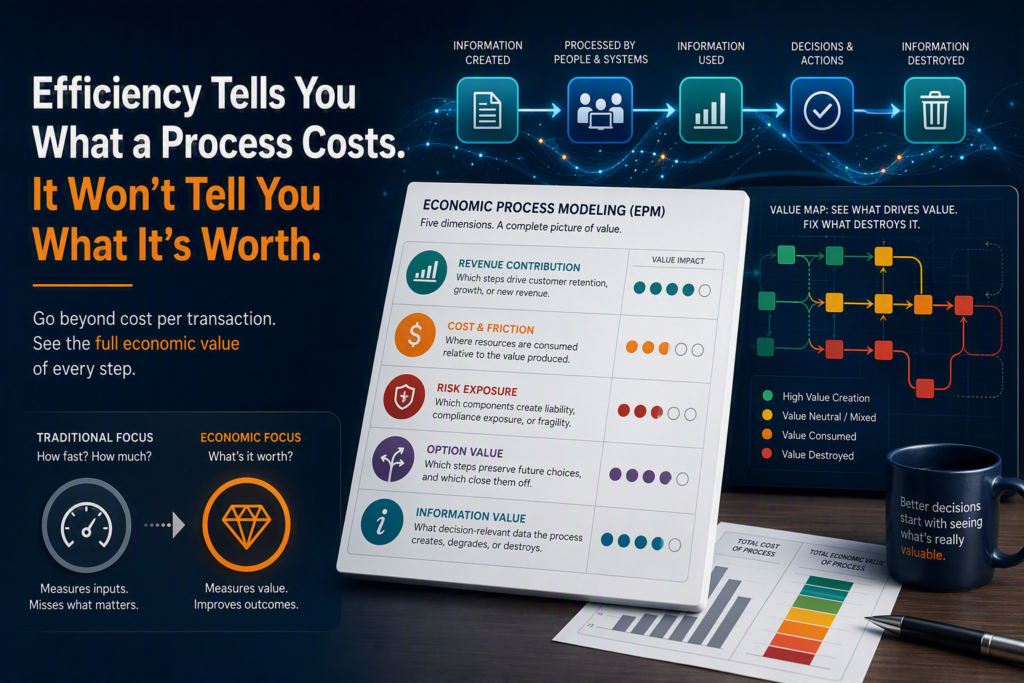
Economic Process Modeling (EPM) is Laney’s answer. It decomposes a process into its components and scores each one across five economic dimensions rather than a single cost axis:
The result is a map of where economic value is generated, where it’s consumed, and where it’s being destroyed in ways no operational dashboard has ever shown you.
The fifth dimension is the one we care about most at LINQ, and the one Laney has been making the case for since Infonomics. Organisations routinely automate a data-generating step in a way that lifts throughput while quietly wrecking the fidelity of the signal that step used to produce. Throughput goes up, the programme gets declared a success, and every downstream decision that depended on that signal gets a little worse. Nobody connects the two, because the two numbers never appear on the same page.
Treating information as an economic asset rather than a byproduct changes which parts of a process you choose to touch.
Reading the article, it’s hard not to notice how closely EPM describes what LINQ models already. LINQ maps a process as connected chains of information, actions, systems, and people, then follows the information as it flows through them. That structure is exactly what economic attribution needs: you can’t score value at the component level unless you can see components and their dependencies in the first place.
From there, the practical part follows. You can model a change before you commit budget to it, see which steps carry the cost and which carry the value, and test whether the automation you’re planning improves the process or hollows out the information it produces. Teams walking into a capital allocation review with that analysis in hand aren’t just arguing more confidently for their number. They’re bringing something an efficiency-only business case can’t answer back to.
Cost reduction remains a perfectly good objective, and processes that are both wasteful and valuable are the easiest wins on the board. The point is narrower and sharper: efficiency shouldn’t be the frame, because the frame decides what gets measured, what gets funded, and what counts as success.
Read Doug Laney’s full article at CIO: Business transformation needs a true economic approach, not guesswork
Want to see what your next transformation is actually worth before you commit to it? Let’s chat.