
LINQ for Business Analysts
The decision-intelligence toolkit for experienced business analysts who are done with static diagrams, rework loops and slow discovery.
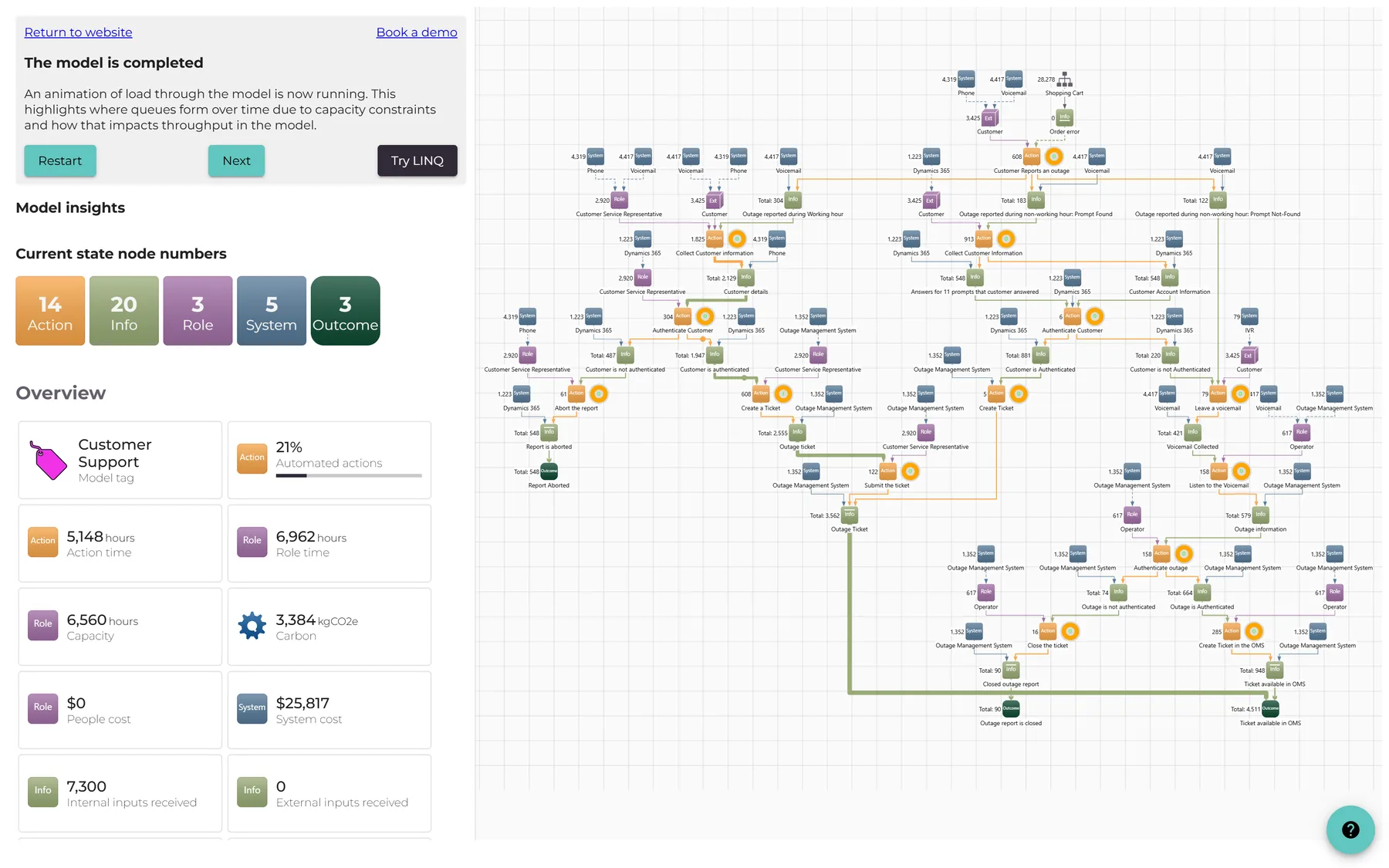
A living digital twin of your organisation
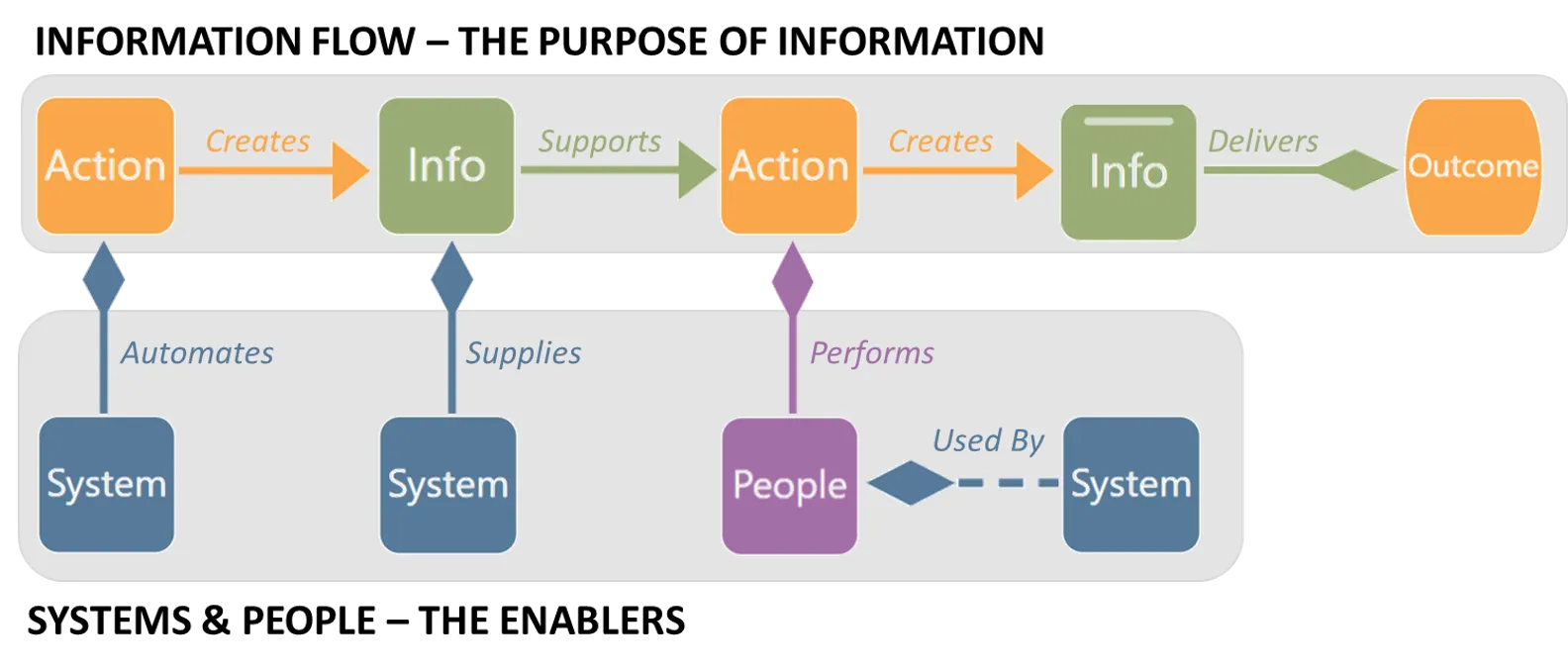
LINQ is an information-first modelling and analysis platform that connects people, processes, systems and information into one quantified model.
Instead of scattered Visio diagrams, whiteboards and spreadsheets, you get a shared model that calculates effort, cost, capacity, value and even carbon for every scenario you test.
LINQ adds what traditional BPMN, swim lanes and mapping tools miss: information supply chains, Lean Six Sigma waste tagging, AI-assisted discovery and built-in scenario simulation.
It is designed so stakeholders actually understand what they see, so workshops run at the speed of conversation and end with quantified, defensible options instead of vague actions.
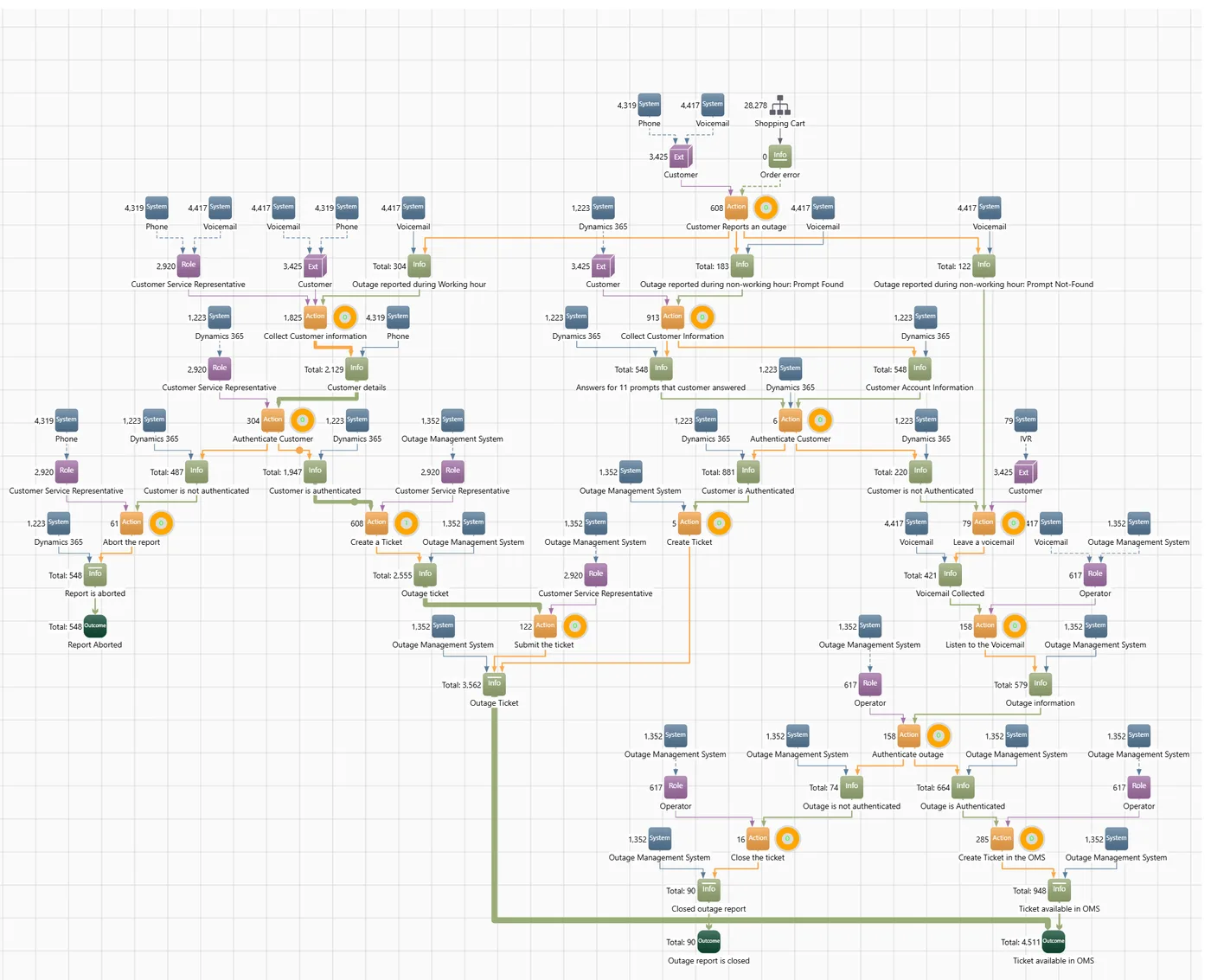
Business analysis is at a crossroads
of transformation projects still fail to deliver expected value, and static ‘as-is’ diagrams are often out of date the moment they are finished.
Analogue-first workshops and manual re-typing into Visio, PowerPoint and Excel create a rework loop that burns BA time and erodes stakeholder trust.
LINQ helps you move to information-first, digital-twin-driven analysis that compresses weeks of discovery into days. You capture reality once, quantify effort and cost as you go, and reuse the same digital twin across initiatives for continuous improvement instead of rebuilding analysis from scratch.
The structured models and insights are great, incredibly intuitive to build and use, but it’s the total experience which makes LINQ truly unique in the marketplace.
See how information really flows
Visualise information flows
Transform complex processes into clear, actionable insights with interactive digital twins.
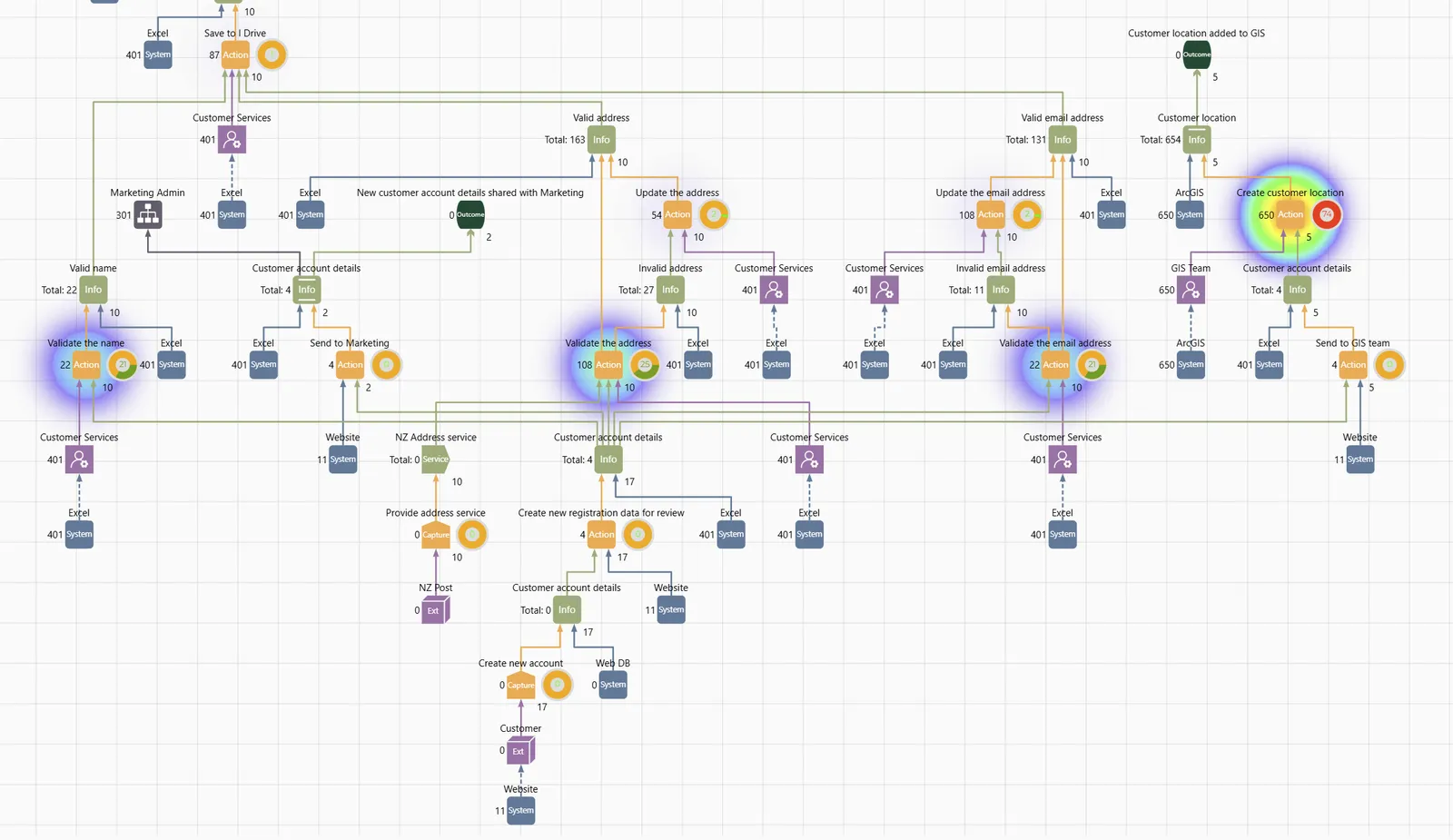
Identify bottlenecks and inefficiencies
Pinpoint where time, money and effort are being wasted.
Optimise decision-making
Make data-driven choices to improve operations and reduce risk.
Improve collaboration
Align teams with a shared understanding of how information supports business goals.
Your end-to-end BA operating system
Model reality, quantify, read insights, test scenarios and decide.
Model reality at the speed of conversation
Run live workshops where you model actions, information, roles and systems directly in LINQ, projected for everyone to see.
Capture how information really flows, including exceptions and workarounds, instead of an idealised process that no one recognises.
Quantify early, not later
Add duration and frequency as soon as actions exist; LINQ automatically calculates effort, cost and capacity for each role and process.
Tag pain points and DOWNTIME wastes (rework, waiting, duplication, over-processing) in real time, so bottlenecks show up in the data, not in hindsight.
Read insights and design scenarios
Use built-in insights to see total cost, time, role utilisation, system value and carbon footprint for your current state.
Clone the model and test scenarios such as automation, AI assistance, policy tweaks or system consolidation, then compare impacts side by side.
Build a defensible business case
Export headline deltas (hours saved, cost avoided, automation %, carbon), role impacts and system changes directly from your quantified model.
Use a simple narrative scaffold (problem, options, quantified impacts, recommendation, risks, measures) to build exec-ready decks in record time.
Control and continuous improvement
Keep your digital twin updated as changes land, using it as a reference for onboarding, benefits tracking and the next wave of improvement.
Standardise your BA rhythm around the LINQ model so discovery, design and benefits realisation become one continuous loop, not disconnected projects.
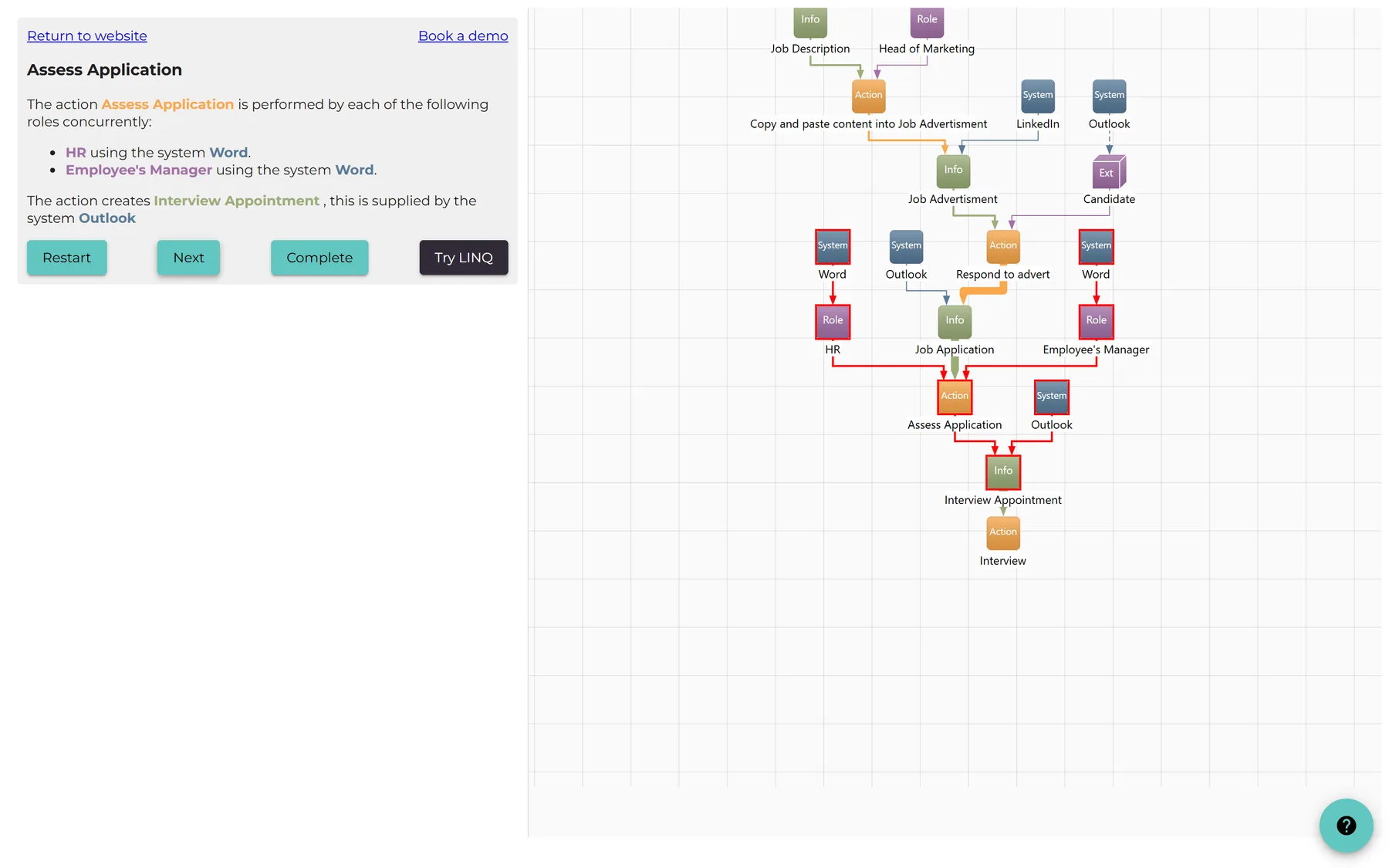
Workshops that end with quantified priorities
LINQ workshops feel different from traditional requirements meetings and sticky-note sessions, and that is intentional.
- Participants see their contributions captured live on screen: every action, hand-off, system and role, with duration, frequency and tags. That builds trust and psychological safety.
- Because modelling, quantification and tagging happen in real time, insight emerges during the session, not weeks later when memories have faded.
- BAs report that quieter voices speak up and people feel ownership because they can literally see their work in the model.
- The group leaves with clear, quantified priorities instead of a long, fuzzy action list.

One client re-ran a completed business case through LINQ and, in a single hour, uncovered a missed impact that increased the value of the change by about 40%.
Apply DMAIC and DOWNTIME to the information supply chain
If you already think in Lean Six Sigma, LINQ lets you apply DMAIC and DOWNTIME to the information supply chain, not just manufacturing or service lines.
- Define and measureModel reality, tag wastes and quantify duration and frequency for every action in the flow.
- Analyse and improveUse insights and scenarios to remove bottlenecks, rework and over-processing before you commit resources or sign off budgets.
- ControlYour digital twin becomes the control layer that sustains improvements over time, making continuous improvement a living practice rather than a one-off project.
Trusted by analysts and change teams
Without LINQ, the process of understanding the value of the opportunity to transform our business would take up to 10 times longer.
 Phoebe DunstanStrategy Analyst, Vix
LINQ wasn’t just a tool for us; it was a revelation. With it, Justin could map out our entire process landscape, making it visible and manageable in ways we hadn’t imagined possible before and at a super-speedy pace.
 Jeremy HoaniHead of IT, Rau Paenga
Our use of LINQ reflects its versatility and depth as a tool for driving business transformation. LINQ integrates seamlessly into Leva’s business process improvement toolkit, providing unparalleled insights that elevate consultancy engagements.
 Vicki TaylorDirector, Leva
Capturing process time directly from a selection of end-users gave us certainty that our data and findings were accurate, rather than having to justify an educated guess.
 Kirsty IrvineSenior Business Analyst, University of Otago
LINQ helped our business identify approximately 134 wasted work hours for every Record Specialist per month, that’s 8,000 hours saved per year.
 COODocuVault
Within a day we had a view of our organisation which allowed us to identify how we could do things differently. After we built our future state we were able to understand the business impact of a change and take that to leadership for sign-off.
 AimeeSenior Recruitment Advisor, New Zealand Defence Force
Identifying where change would add the most value to the operation in both of our strategic projects has enabled us to build the evidence-based case internally, getting the entire business moving in the same direction to deliver real value to our customers, more quickly than we would have otherwise managed to achieve.
 Simon SmithChief Technology Officer, Vocus
Measurable results across sectors

3,500 hours recovered from inefficient processes
Read the story
$140k and 8,000 hours of operational costs saved per year
Read the story
Collapsed 80 steps down to 20 in a single process
Read the story
1,827 hours saved per year
Read the story
Saved 10,000 hours of time from procurement processes per year
Read the storyCompress weeks of discovery into days
Start modelling for free with up to 150 nodes, or book a call and we will walk you through LINQ with your own process.
Not ready to sign up? Walk through a real LINQ model