

Prove the ROI of your next change

That’s a wrap on the first LINQ Conference!

Thank you to our brilliant presenters and to everyone who joined us across both days. It was a big moment for us as we launched LINQ Version 3, with Economic Process Modelling now built right into the platform.

We’ll be sharing the session recordings and presentations with you soon. See you at the next one!

  • 11 sessions
  • 2 keynotes
  • Free to watch

Why you should still sign up

For business analysts and practitioners

  • See the first look at LINQ Version 3, then learn how to get the most out of it
  • See exactly how Economic Process Modelling works inside LINQ, whether you’re the one capturing the data or presenting the results
  • Hear how an analyst at WDI with almost no LINQ experience got up to speed fast enough to support live client delivery
  • Learn how to map current state properly before designing AI into the future state
  • Take away a three-question test for finding “heirloom work”, the reports and routines nobody remembers asking for

For leaders, PMOs and transformation sponsors

  • Get the full economic case for transformation from Doug Laney, the person who wrote the book on measuring what information is worth
  • See how to trace the ROI of AI back to a real process and decision, before you commit budget on conviction alone
  • Hear real results, from the gap between what BI reported and the real effort at the Department of Corrections, to where Intelligent Process Automation is delivering measurable value
  • Learn the change patterns that repeat across a decade of transformation, and how to decide which processes to rebuild, amplify or leave alone

Every presenter, every topic

A summary of each session and its key takeaways. Recordings of every session we can share are on their way.

The recordings are on their way. Sign up free and we’ll email them to you as soon as they’re ready.Sign up

You’re on the list. We’ll email you as soon as the recordings are ready.

Keynotes

Doug Laney

Doug Laney

Data, Analytics and AI advisor, researcher and author

Introducing Economic Process Modelling: The Marriage of Metrics and Transformation

Most organisations still measure their processes on cost alone, which is why so many transformation programmes, AI included, run on conviction rather than economics. Doug’s keynote introduces Economic Process Modelling (EPM), a way of reading every process as an asset factory that produces revenue, reduces risk, creates options and generates information, not just cost.

Key takeaways

  • Ask what each part of a process is worth, not just what it costs: EPM reads every step through five lenses, revenue, cost, risk, options and information
  • What a step costs is not what it’s worth. In Novopay, testing, assurance and local knowledge looked like expenses on the project plan until they failed
  • Before removing the step everyone complains about, work out what it actually contributes. It may be protecting more than it costs
  • Don’t start with “where can we apply AI?” Pick one process with real economic exposure, model it, and compare a couple of credible redesigns

Recording coming soon

Doug Laney is the person who put a name to the value of information. He originated infonomics, wrote the bestselling book of the same name, and followed it up with Data Juice: 101 Real-World Stories of How Organisations Are Squeezing Value from Available Data Assets. He’s a three-time Gartner thought leadership award winner, a World Economic Forum advisor, a Forbes contributing author, and co-chairs the annual MIT Chief Data Officer Symposium.


Alison Holt

Alison Holt

e-Judiciary Adviser to the Chief Justice of Papua New Guinea, Longitude 174 Limited

Mapping the Constitution, Modelling the Courts: A Conversation on Digital Justice

In this interview session, Alison talks through the realities of building digital justice systems: what it takes to design services for one of the most complex, highest-stakes sectors there is, why a digital twin matters for planning, and how her team came to map the Constitution of Papua New Guinea itself.

Key takeaways

  • Model the whole system before adding resources: appointing more judges only moves the bottleneck if courtrooms, ushers or prosecutors are the real constraint
  • A digital twin of the judiciary lets costly decisions be trialled without moving a single person
  • Start from first principles: mapping the Constitution showed what has to be in place before a judge can even be appointed
  • Modelling court-ordered mediation, stage by stage, showed how many mediators the country really needs

Recording coming soon

Alison Holt is an internationally recognised expert in data governance, with a career spanning director, general manager, research fellow and virtual CIO roles. She’s authored three books on IT and data governance and has spent the last eight years as e-Judiciary Adviser to the Chief Justice of Papua New Guinea.

Partner and Customer Sessions

Christian Schroeder
Natasha Eldridge

Christian Schroeder & Natasha Eldridge

WDI, a Division of NV5

From Tribal Knowledge to Operational Intelligence: WDI’s Rapid Use of LINQ in Utility Transformation

Utilities are being asked to modernise faster while managing ageing infrastructure, workforce turnover, fragmented systems and pressure to prove the value of transformation. This session shows how WDI rapidly adopted LINQ and put it into live client delivery, with examples from its work with Xcel Energy and Discount Tire.

Key takeaways

  • Model the process before choosing the technology: automation is one possible outcome of understanding, not a substitute for it
  • Value leaks at the interfaces. Watch for “human APIs”, the people carrying information between systems by hand
  • Capture the gap between work as planned and work as practised now: around half of utility employees are projected to retire within a decade
  • Quantify before you propose: WDI costed a claims automation first, taking the estimated cost per claim from $7.25 to six cents

Recording coming soon

Christian Schroeder is Director of Growth at WDI, a Division of NV5, where he helps utilities strengthen the systems, data and workflows that drive safety, reliability and customer affordability. With more than 20 years across utility operations, technology integration and operational transformation, his work spans utility data remediation, GIS modernisation, workflow redesign, process automation, and ADMS and digital twin readiness.

Frazer Weir

Department of Corrections

Business Intelligence Meets Process Reality

The department signed up to an SLA that looked easily achievable, built around a report thought to take eight hours to create. But business intelligence was measuring completion, not effort, and LINQ surfaced some uncomfortable insights about what the process really involved.

Key takeaways

  • A KPI was set by asking how long a report takes to write, not how long it takes to gather what goes into it: the travel, the consents and the police checks
  • Before removing the step everyone complains about, find out what it protects: one “quiet achiever’s” work turned out to underpin an accreditation
  • LINQ works as a Rosetta Stone between the “doers” and the “counters”, giving the BI report and the real work a common thread
  • Model the alternatives before you commit: a telephone interview in place of some home visits cut both the cost and the time of each report

Recording coming soon

A business analyst since the last century and a long-term LINQ user, Frazer has a background in banking, energy, education and justice, with management and leadership roles alongside keeping his hands dirty actually doing the work.

John Baigent

John Baigent

Co-founder, Attune Solutions

Pattern Intelligence

AI is pattern recognition, and so is your team, if you look closely enough. Using a real current-state mapping project in LINQ, John shows what current state really looks like once it’s mapped properly, then how to design a future state with AI built in from the start, so the ROI is something you can trace, not just claim.

Key takeaways

  • Model the real process, not the documented one: a process documented in two steps turned out to have 23 actions
  • Name the human patterns AI will land in: Provenance Reflex, Accountability Drift and Context Drag
  • Get the order right: people first, process second, and AI last, designed into the future state
  • Cost is easy to measure, but value is where the case is: a saving of about $2,200 a year sat alongside tens of thousands of dollars in recovered commission and new lending

Recording coming soon

John Baigent is co-founder of Attune Solutions, a people-first AI transformation consultancy based in New Zealand. An early adopter of LINQ, John has used it for years to map organisational complexity, and now helps boards and owner-operators design AI into the future state of their business rather than adding it as an afterthought.

Jovita Roy

Jovita Roy

Director, JLR Advisory Group

From Diagram to Dollars: Why Information Flow Is Your Real Business Asset

Most organisations map their processes, but few understand what those maps are actually worth. Drawing on 10 years of hands-on LINQ modelling, Jovita shows how to turn a static LINQ diagram into a decision-driving tool that quantifies waste, risk and opportunity, using the Economic Process Modelling framework.

Key takeaways

  • The cost hides between the boxes. Count how many systems hold a customer’s address: four or more means expensive syncing and nobody owns the truth
  • Put a dollar figure on it: staff chasing an order’s status across five systems was costing a utility millions a year
  • Walk the model with the people who do the work, and get the durations, rates and frequencies right. A credible range beats precise-looking guesses
  • Match the fix to the failure: substitute, eliminate or resequence

Recording coming soon

Jovita Roy is a senior consultant with more than 30 years of experience in utility GIS transformation, business process modelling and organisational change management. She is based in Fort Worth, Texas.

Kirsty Sylvester

Kirsty Sylvester

Senior Agile BA and Transformation Coach, Fire and Emergency NZ

Heirloom Work: The Most Expensive Thing Nobody Asked For

Every organisation carries heirloom work: reports, reconciliations and routines handed from one person to the next long after anyone remembers why. Kirsty shows what this looks like in LINQ, and the moment heirloom work becomes undeniable: one output sits apart from everything else, with nothing depending on it.

Key takeaways

  • Heirloom work has four traits: it’s inherited, it’s outlived its purpose, nobody owns it, and it hides inside job descriptions
  • A three-question test: who actually uses this, what does it connect to, and who would notice if it stopped?
  • In LINQ, heirloom work stands out on its own: an output with nothing depending on it
  • One unread report cost $12,691.20 a year, and the person building it was relieved to stop. Give people the space to say so

Recording coming soon

Kirsty Sylvester (they/them) is an agile business analyst at Fire and Emergency NZ and neuroscience postgraduate who specialises in helping organisations make sense of complexity, with more than a decade of experience working across government agencies and organisations in New Zealand, Australia and the United States.

Craig Blake

Craig Blake

Managing Director, Better Business by Design

Beyond the Hype: How Intelligent Process Automation Delivers Real Business Outcomes

Intelligent Process Automation is about more than automating tasks. Craig shares practical examples of how AI, automation and people are being combined to reduce costs, improve customer experiences, increase productivity and transform business operations, and how organisations can get started.

Key takeaways

  • Not everything needs AI: deterministic work runs faster and far cheaper with process automation, so save AI for the judgement calls
  • Combine process automation, AI and people: one process went from 10 minutes to 37 seconds, plus a human decision
  • In one priced comparison, process automation with people doubled the saving of a full AI implementation and shortened the payback
  • Measure the baseline first: LINQ models the before, so the after can be proven

Recording coming soon

Craig Blake helps organisations get more value from technology by asking a deceptively simple question: what business problem are we actually trying to solve? At Better Business by Design, he works across business transformation, AI, intelligent automation, cloud, procurement and commercial strategy.

LINQ Sessions

Neil Calvert

Neil Calvert

Founder and CEO, LINQ

Introducing LINQ Version 3

The first look at LINQ Version 3. See how Economic Process Modelling, now built directly into the platform, connects your processes to the value they create. Neil walks through the new functionality in the release and shows how it turns a process model into a clear economic case for change.

Key takeaways

  • EPM is now built into LINQ: every model is scored for revenue, cost, friction, waste, risk, option value and information value
  • The scorecard finds manual bridges, rekeying, dead ends and over-allocated roles, and shows you where in the model each one sits
  • AI can draft a model from a document or transcript, and turn the recommendations you pick into a future-state model to compare with today’s
  • Check what AI builds with the people who do the work: it still needs their knowledge of the business

Recording coming soon

Harry Williams

Harry Williams

LINQ Analyst and Consultant, LINQ

Getting the most out of LINQ Version 3

Straight after the Version 3 launch, get hands-on with the new release. Harry shares the tips, shortcuts and techniques that help you model faster and get more value from LINQ Version 3, whether you’re new to LINQ or a long-time user.

Key takeaways

  • Set information subtypes and system types (system of record, business system or local tool): EPM uses them to find friction and risk, like a manual bridge by email
  • Mark exception work and waits, so they show up as friction and waste in the EPM scorecard
  • Give each output a value per item, as revenue or a relative score, and LINQ shares it back to the work that created it
  • Use “joins to” when work carries on into another model, and “used in” when it’s only looked up, so the workload stays right

Recording coming soon

Neil Calvert

Neil Calvert

Founder and CEO, LINQ

Same problems, different organisations: a decade of change patterns and what comes next

After a decade of modelling change in very different organisations, the same problems keep surfacing. Neil shares the recurring patterns LINQ has seen, why they repeat, and where process, information and AI are taking transformation next.

Key takeaways

  • Most organisations don’t have a current state: it gets documented when something forces it, then goes stale. Give the model an owner and treat it as an asset
  • The problem is rarely the platform: rules that make sense on paper create repeat demand and cost a fortune end to end
  • Where the process leaves a gap, people become the glue, and the outcome depends on who you get
  • Count worth, not hours: hours saved get a project approved, but boards fund value, and slow decisions cost more than we think

Recording coming soon

What’s new in LINQ Version 3

  • EPM built in

    Economic Process Modelling inside the platform, from capturing value metrics to reading the results.

  • AI, without the guesswork

    Model what changes when AI enters a process, before you commit a dollar.

  • Bottlenecks in real time

    See where work backs up and what it costs, then model the fix.

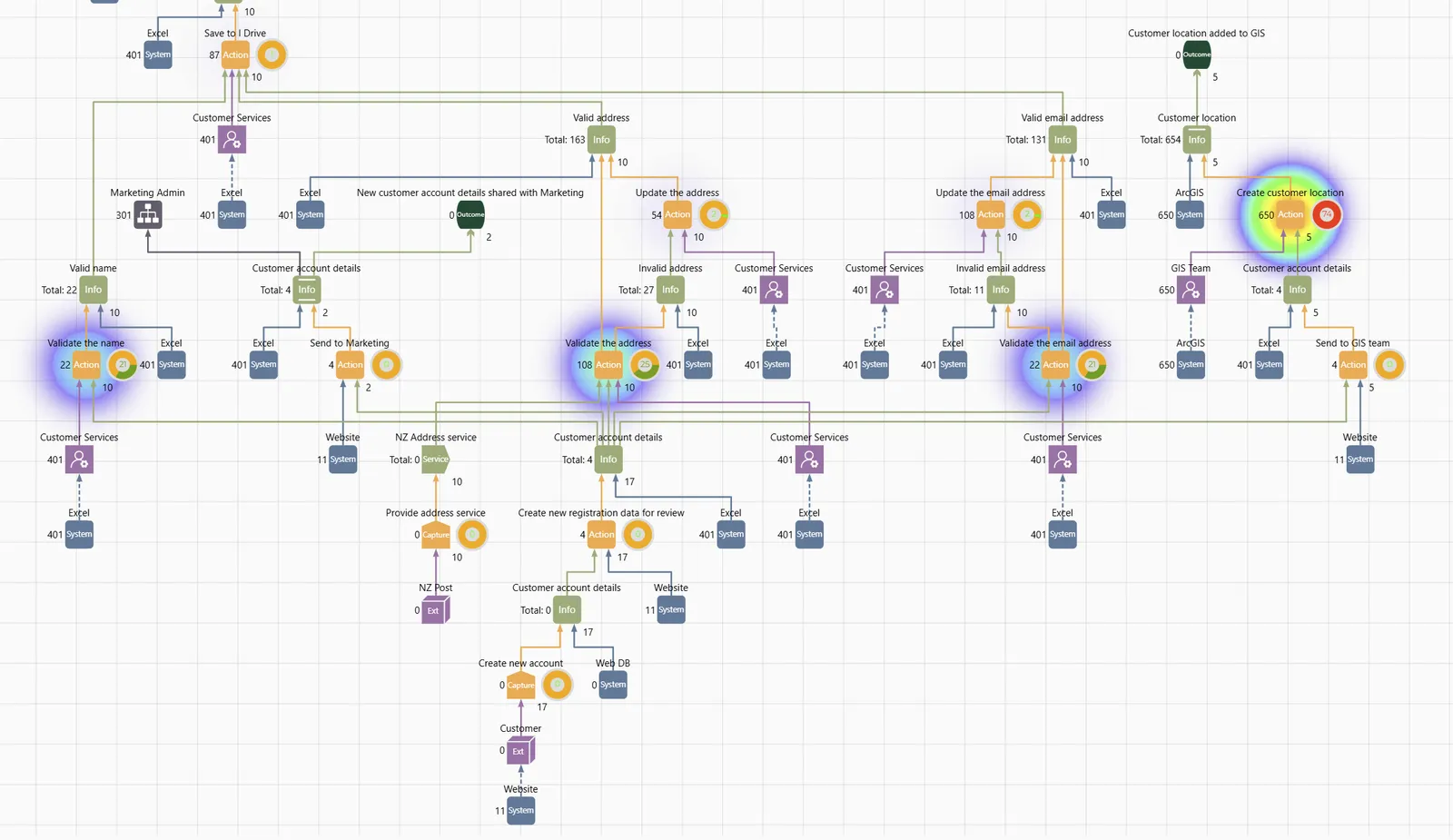
LINQ highlighting bottlenecks in a modelled process

Get the recordings when they’re ready

Free, and you only do it once

You’re on the list

Share your details and we’ll email you the recordings as soon as they’re ready

We’ll email you as soon as the recordings are ready

Browse the sessions

What happens next

  1. We’re editing the recordings now.
  2. As soon as they’re ready, we’ll email you a link to watch them on any device.
  3. You only sign up once: you won’t need to fill in the form again.

We’ll use your details to give you access to the recordings and to send you updates from LINQ. You can unsubscribe at any time.

Sign up for the recordings

FAQs

Does it cost anything?

No. The recordings are free to watch. We just ask for your contact details once.

When will the recordings be ready?

We’re editing them now. Sign up once and we’ll email you as soon as they’re ready.

Which sessions will there be recordings of?

Every session our presenters have agreed to share. Sessions without a recording say so on their card.

I registered for the conference. Do I need to sign up again?

No. Everyone who registered for the conference will be emailed the recordings automatically.

Can I share the recordings with my team?

Please send them to this page, so they can sign up for their own access.

Who can I contact with a question?

Email support@thinklikelinq.com and the LINQ team will get back to you.

Questions? Email support@thinklikelinq.com

Missed the conference? Get the recordings.

Sign up free and we’ll email you the keynotes, customer stories and the first look at LINQ Version 3 as soon as they’re ready.