
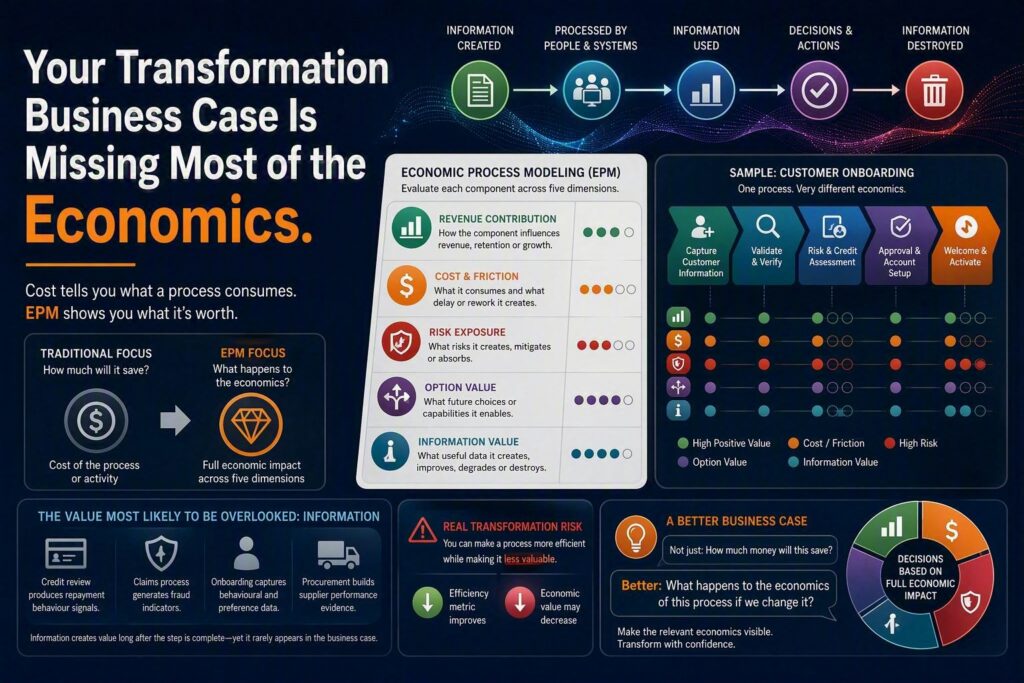
When a business analyst proposes changing a process, one question tends to arrive quickly: How much money will this save?
Cortney Pagel, Senior Business Analyst and Change Manager at Arcadia, formerly ENGIE Impact, encounters it regularly. The problem is that while organisations can often identify what a process costs, they have a much harder time connecting those economics to the individual components of the work. At one point, Cortney resorted to putting cost estimates into comment bubbles on process diagrams because there was no systematic place for them.
But even better cost attribution only solves part of the problem.
In our previous post, Efficiency Tells You What a Process Costs. It Won’t Tell You What It’s Worth, we introduced Economic Process Modelling (EPM) as a way to look beyond efficiency and understand what the components of a process actually contribute economically.
Increasingly, building a solid business case for transformation requires this level of scrutiny and detail.
Certainly, traditional financial systems focus on tracking consumption, general ledgers tell us what departments and cost centres spend, and activity-based costing (ABC) can attribute those costs more precisely to activities. However, transformation decisions require answers to a broader set of questions:
Cost accounting was not designed to answer most of those questions. As a result, transformation business cases can become highly precise about savings while remaining surprisingly vague about value.
Consider the process of customer onboarding.
Some activities establish the relationship and influence retention. Others collect information that enables future cross-selling. Validation steps may reduce fraud or compliance risk. Meanwhile, duplicate checks, unnecessary approvals and manual system handoffs may create cost and friction without adding meaningful value.
A conventional process-cost number compresses all of that into one figure. EPM instead evaluates process components across five dimensions:
Each of these components matter because transformation does not happen to an abstract end-to-end process. Teams automate, eliminate, combine, outsource or redesign individual components. The economics need to be visible at the same level where those decisions are made.
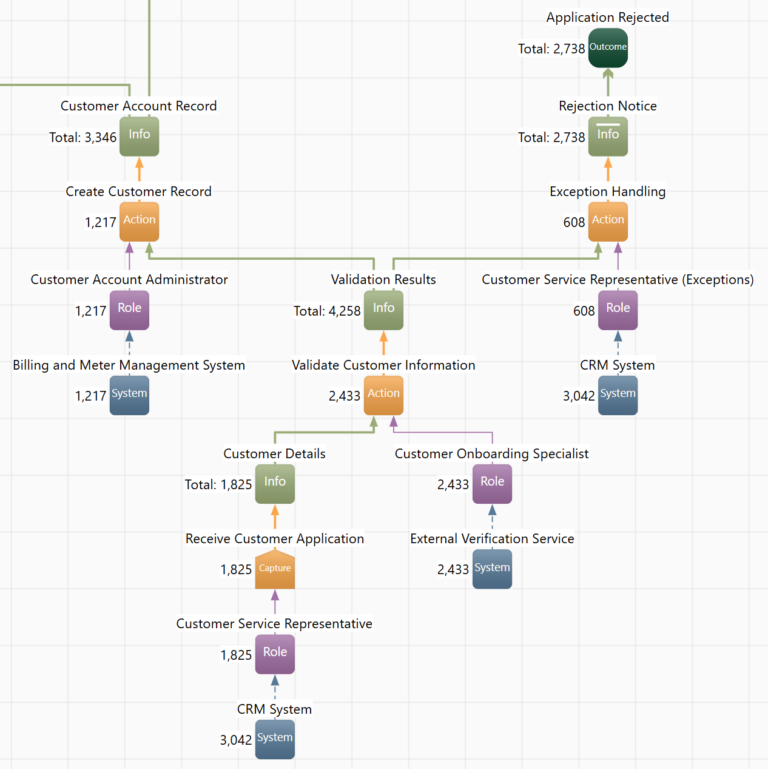
Information may be the economic contribution organisations miss most often.
Processes generate data simply by operating:
That information may continue generating value long after the process step that created it is complete.
Yet it rarely appears in the business case.
This creates a real transformation risk: an organisation can make a process more efficient while simultaneously making it less valuable. Automating a step may reduce cycle time while degrading information used by multiple downstream decisions. The efficiency metric improves; the economics may not.
Suppose a process component costs $500,000 annually. It may appear to be an obvious automation candidate. But the decision changes if that component also:
Conversely, a relatively inexpensive activity may destroy considerable value through delay, rework or customer attrition.
The point is not to manufacture precise dollar values for everything. It is to make the relevant economics visible enough to influence the decision.
So “How much money will this save?” remains a useful question. It just shouldn’t be the only one.
A better question is: What happens to the economics of this process if we change it?
Economic Process Modelling gives organisations a way to answer that question before they automate away something they may later discover was more valuable than it looked.
We’re working with Doug Laney to define what EPM is. You can read his full CIO Magazine article here: Economic Process Modeling: Business Cases Beyond Cost Accounting
Want to see what your next transformation is actually worth before you commit to it? Let’s chat.