A Digital Twin of Your Business Needs to Show More Than How Work Flows
Manufacturers have used digital twins for years to understand how physical assets behave, predict failures and test changes before making them. Yet when businesses want to understand the consequences of restructuring a team, automating a process or introducing AI, they often fall back on workshops, spreadsheets and educated guesses.
In his latest CIO article, Doug Laney argues that the next significant opportunity for digital twins lies in modelling the enterprise itself, with an important addition: understanding the economic value of the work being performed.
This is particularly relevant to us at LINQ, where we’ve long believed that meaningful transformation begins with understanding how people, processes, systems and information interact.
A map of the business is only the starting point
Most organisations already have plenty of documentation describing how they operate. Organisation charts show reporting structures. Process diagrams show workflows. Financial systems track spending.
The problem is that these views rarely connect, and they generally describe how the business was designed to operate rather than what is actually happening.
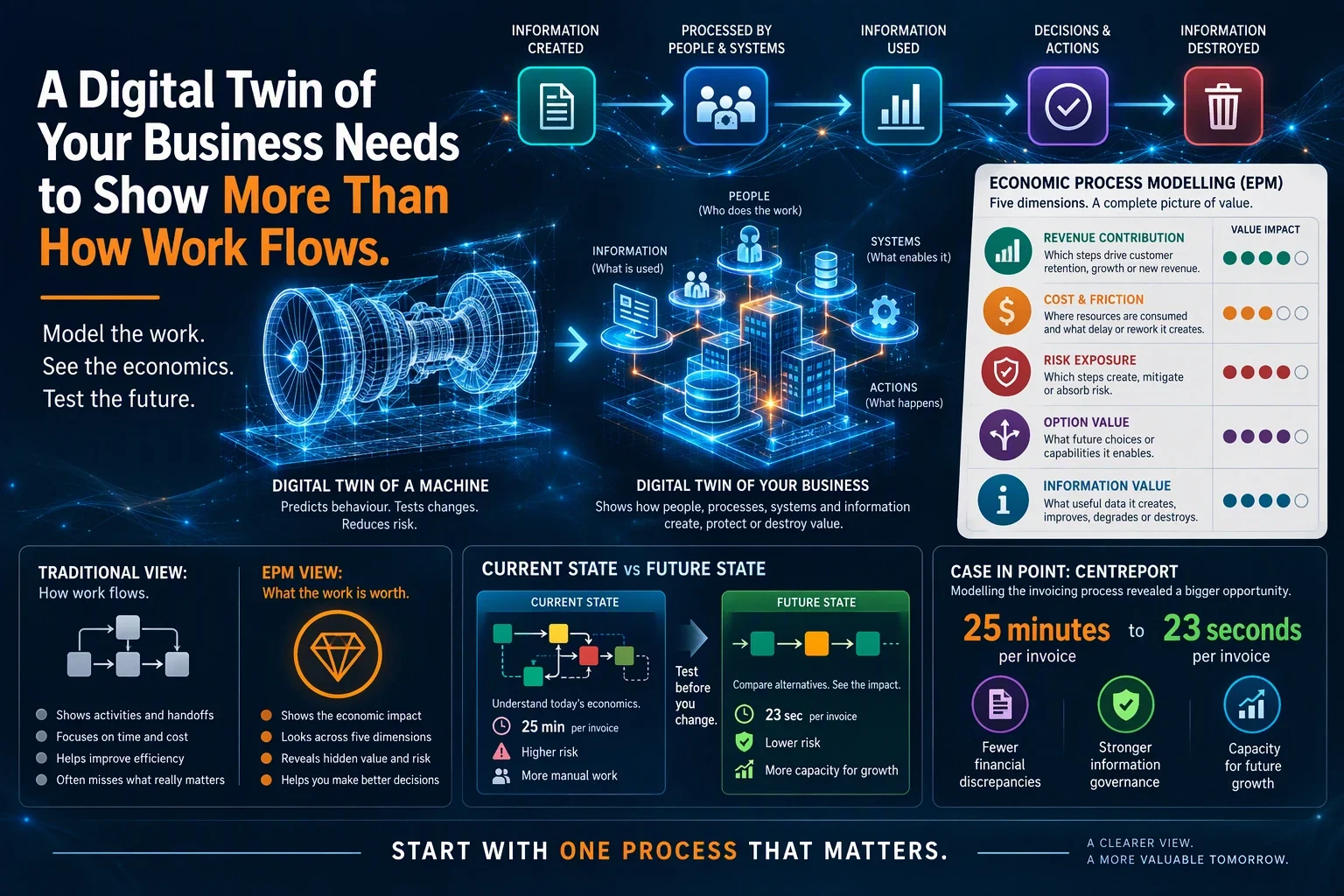
A digital twin of the organisation brings those perspectives together. It creates a model that can help teams understand dependencies, identify bottlenecks and explore the consequences of changing how work gets done.
But there’s another question that deserves equal attention: What economic value does each part of that work create, protect or potentially destroy?
Without that understanding, a business can become remarkably efficient at doing things that contribute very little value.
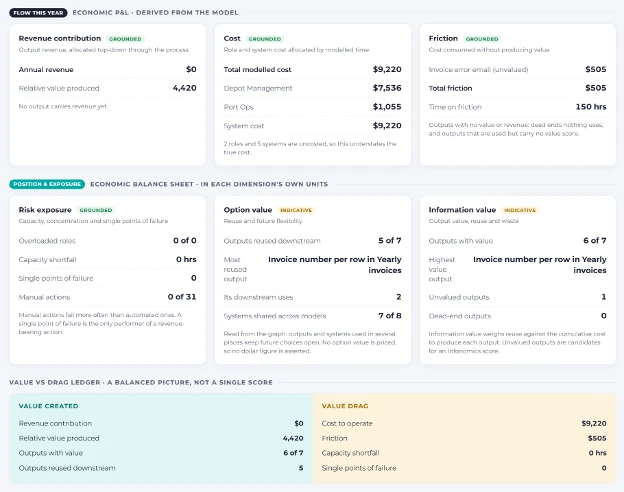
Adding the economics to the digital twin
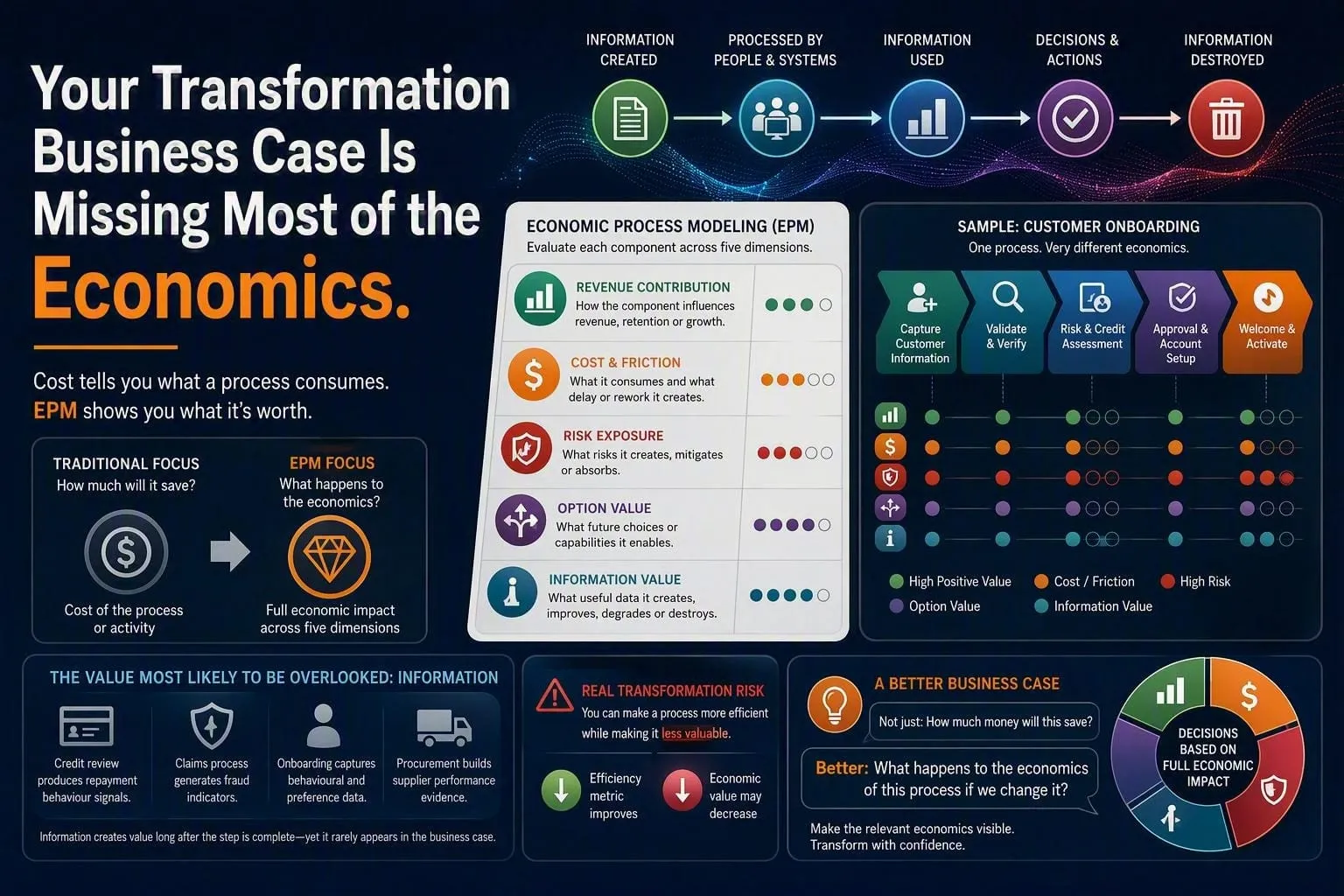
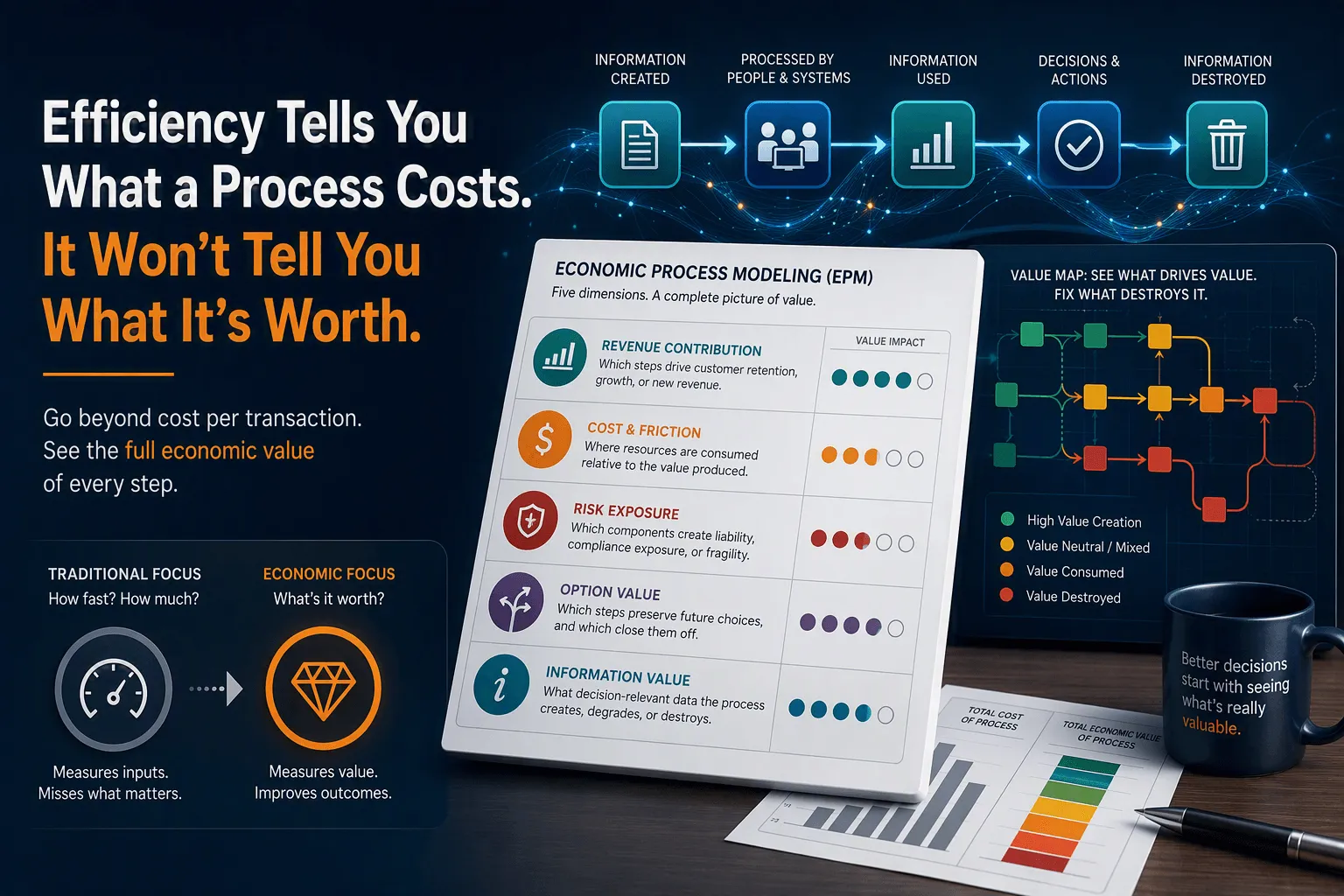
In our recent posts on Economic Process Modelling (EPM), we’ve explored why process improvement needs to look beyond cost and efficiency.
EPM introduces five dimensions of economic value: revenue contribution, cost and friction, risk exposure, option value and information value.
Consider a customer onboarding process. One activity may appear expensive because it requires human judgement, but that same activity might prevent fraud, strengthen customer relationships or generate information that improves future decisions.
Remove it based solely on cost, and the resulting process may be faster but economically worse.
Now imagine being able to explore those trade-offs in a digital twin before committing to the change.
That’s where economic modelling becomes particularly powerful. It allows leaders to compare alternative process designs based on their broader contribution to the business, rather than simply how much time or money they might save.
From understanding the business to testing its future
LINQ already enables organisations to model the relationships between information, actions, systems and people, and quantify how work consumes time, cost and capacity.
It also allows teams to compare current and proposed future states, testing the potential impact of automation, resource changes and process redesign before implementation.
Economic Process Modelling extends that capability by bringing additional dimensions of value into the analysis.
A practical example is CentrePort in New Zealand, where modelling the invoicing process helped reduce processing time from 25 minutes to just 23 seconds per invoice. Beyond the substantial efficiency improvement, the changes also reduced financial discrepancies, strengthened information governance and created capacity for future growth.
Those broader benefits matter. A transformation decision that considers only processing time would miss much of the economic opportunity.
Start with one process that matters
Creating a digital twin of an entire enterprise may sound ambitious, and it is. Fortunately, organisations don’t need to model everything before they can start making better decisions.
A more practical approach is to select a process already facing significant transformation pressure, particularly one involving AI investment, operational risk or substantial information flows.
Model how it operates today. Understand where value is created and lost. Test what happens when individual activities, technologies or responsibilities change. Then use actual performance data to refine the model and its economic assumptions.
Over time, connected models can provide a progressively richer picture of the organisation, supporting decisions that span functional boundaries.
The real opportunity is to make economic understanding an ongoing management capability rather than something reconstructed for each business case.
After all, if we can use digital twins to understand and optimise the performance of a turbine, why shouldn’t we apply the same discipline to understanding and improving the economics of an entire business?
Read Doug Laney’s full article at CIO: The Next Digital Twin Isn’t of a Machine, It’s of Your Business.
Want to explore what a digital twin could reveal about the economics of your organisation? Let’s chat.