The Next Outage Has a Price. Do You Know Yours?
When Microsoft 365 faltered on 12 November, businesses around the world lost access to email and other services they rely on to get work done. Some found ways to carry on with phones, faxes and makeshift workarounds. Others discovered just how much of their business depended on a single technology provider.
Microsoft’s preliminary post-incident analysis points to a combination of a dormant software defect, shifted traffic and reduced server capacity. Together, those problems helped turn an infrastructure issue into a widespread disruption. The technical details are instructive, but there’s a more immediate question for every organisation dependent on cloud services: What would an outage like this actually cost us?
In his latest CIO article, Doug Laney explores the economics of prevention through Economic Process Modelling (EPM). His argument has a rather uncomfortable implication for traditional efficiency programmes: some of the most valuable parts of a process are the ones that appear to do nothing, until something goes wrong.
Start with the business process, not the outage
An IT team can tell you how long a service was unavailable. That doesn’t tell the finance team what the interruption cost the business.
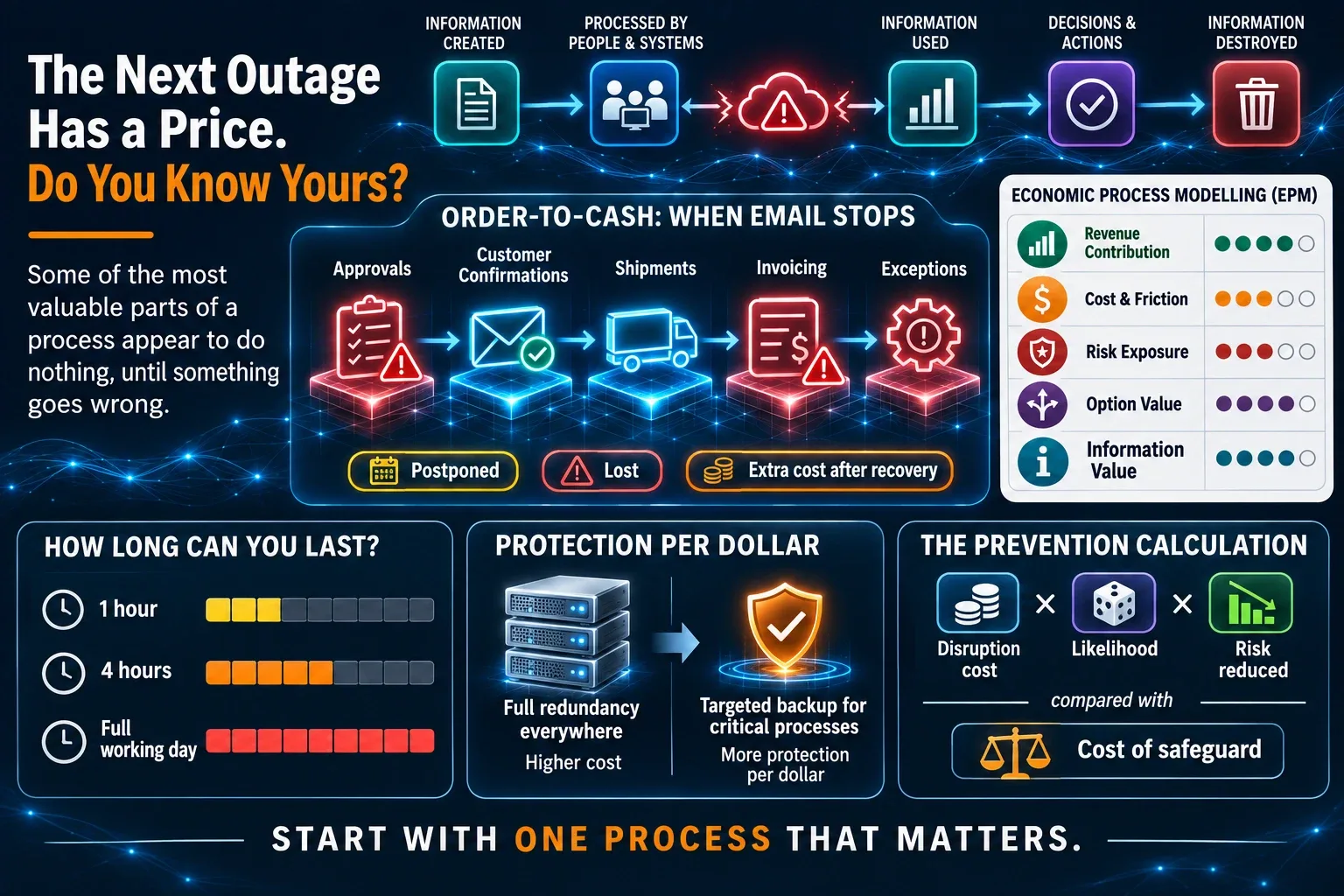
Imagine an order-to-cash process that depends on email for approvals, customer confirmations and resolving exceptions. When email stops, the consequences may spread into delayed orders, missed shipment windows, invoices that cannot be issued and customer enquiries that take longer to resolve. Some of that work is merely postponed. Some may be lost altogether. And some generates extra costs long after the service comes back.
Those distinctions matter. Treat every interrupted hour as lost revenue and the business case becomes inflated. Count only IT recovery costs and it becomes dangerously incomplete.
Put an economic value on staying operational
A conventional process model shows how work moves between people, systems and information. LINQ lets teams explore those connections, quantify time, cost and capacity, and compare different ways of operating. That creates a practical starting point for identifying which activities and dependencies would be affected by a disruption.
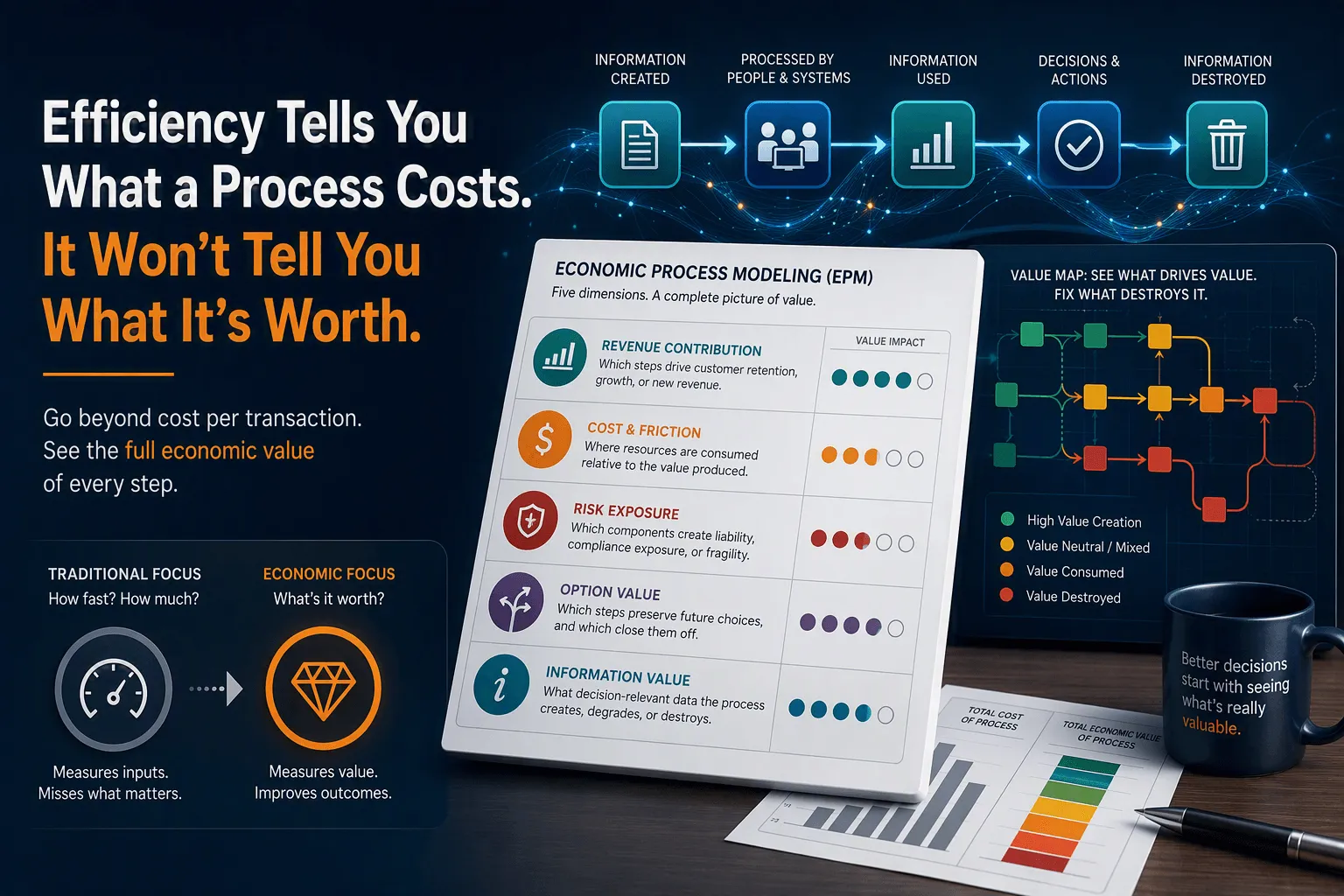
EPM adds an economic perspective. Alongside revenue contribution and operating cost, it considers risk exposure, option value and information value. Those additional dimensions help explain why spare capacity, a manual workaround or a second communications route may be worth retaining even when they are rarely used.
Consider two alternatives. One organisation pays for full technological redundancy across every function. Another preserves a simpler backup route for just the few processes where an interruption would have serious financial consequences. The second may deliver much more protection per dollar invested. Equally, a safeguard that seems extravagant on a cost-per-transaction dashboard may be entirely justified once expected interruption losses are included.
The calculation need not be elaborate. Estimate the financial consequence of a credible disruption, how often it might occur, and how much a proposed safeguard could reduce the exposure. Use ranges where uncertainty is substantial. Then compare the expected benefit with the ongoing cost of the safeguard. This will not predict every failure, but it can improve decisions about which vulnerabilities deserve attention first.
Model a failure before it becomes your problem
Here is a useful exercise for a business analyst, CIO or transformation leader. Select one commercially important process, then trace its reliance on email, identity, cloud applications, external partners and the people who make decisions. Ask what happens after one hour without a critical service, after four hours, and after a full working day.
Next, compare feasible responses: an alternative communications channel, an offline approval procedure, additional system capacity or a different way of routing work. In LINQ, the current process and proposed changes can be represented and compared. The economic assumptions about disruption losses and avoided risk then help complete the investment case.
This is a more useful conversation than arguing over whether a backup system is underutilised. The object is to find out which contingencies preserve the most business value, and which simply add expense.
A modest exercise with potentially substantial returns
You don’t need to model the entire enterprise or forecast a catastrophic technology failure with scientific precision. Begin with one process whose interruption would matter to customers, cash flow or regulatory obligations. Bring operations, technology, risk and finance into the same discussion, and test a few plausible scenarios.
The result may be a smaller resilience budget, better spent. It may also uncover an inexpensive precaution that protects considerably more value than its price tag suggests. Either would be an improvement on discovering your dependencies for the first time during an outage.
Read Doug Laney’s full CIO article: What Microsoft’s Outage Reveals About the Economics of Prevention.
Want to see which parts of your business are worth protecting first? Explore Economic Process Modelling with LINQ, or talk to us about modelling a critical process.